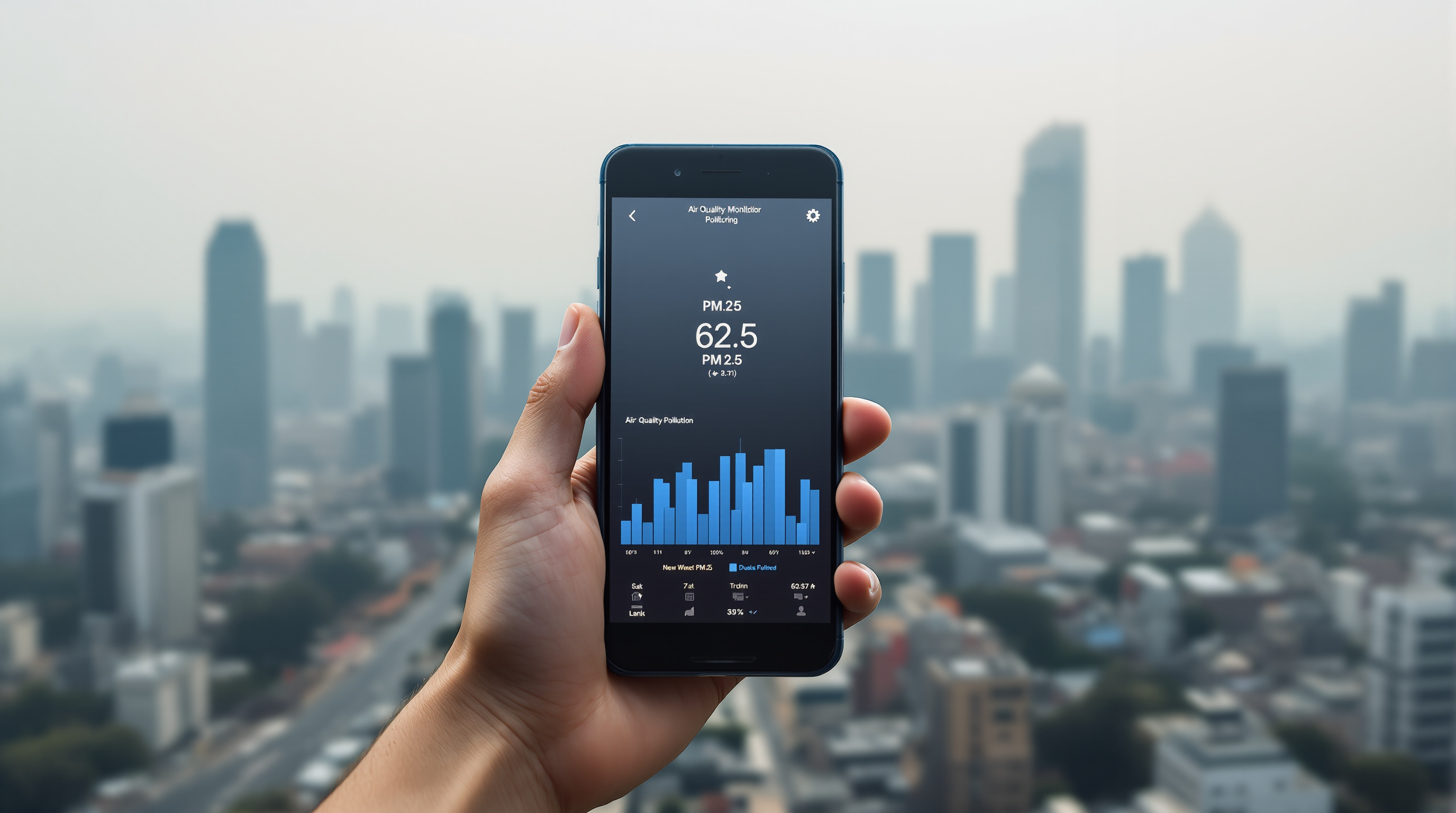
The Scale of India's Air Pollution Crisis
India is home to 14 of the 15 most polluted cities in the world as measured by PM2.5 particulate matter concentration. Delhi, the country's capital, regularly records air quality levels dozens of times above World Health Organization safety thresholds. The human cost is staggering: respiratory illness, cardiovascular disease, and shortened life expectancy for tens of millions of residents.
Addressing this crisis requires two things that existing government monitoring systems often fail to provide: real-time data at fine geographic granularity, and predictions that give residents advance warning so they can modify behavior. A team of eight engineering students built two complementary systems to address exactly these gaps.
The WHO ambient air pollution fact sheet gives a dated global reference: in 2019, 99% of the world's population lived in places that did not meet WHO air quality guideline levels. Of the estimated 4.2 million premature deaths attributed to outdoor air pollution that year, 89% occurred in low- and middle-income countries, with the greatest numbers in the South-East Asia and Western Pacific Regions. WHO's guidelines also include interim targets intended to support gradual movement toward lower pollutant concentrations. An interim target should therefore be identified as a step toward the guideline value. When presenting a pollution estimate, a student team should make clear which benchmark it is using and distinguish an estimated reading from a confirmed measurement.
Team 1: Temporal Forecasting with LSTM Neural Networks
The first student team developed CLair — a machine learning model trained on historical data from India's Central Pollution Control Board. CLair generates 24-hour air quality forecasts based on real-time readings of multiple pollutants: sulphur dioxide (SO₂), nitrogen dioxide (NOₓ), PM2.5, and PM10.
The model also tracks seasonal variation in pollutant sources — identifying patterns in how pollution changes across seasons and correlating them with known sources like vehicular traffic, agricultural burning, and industrial activity. Technically, CLair uses Long Short-Term Memory (LSTM) neural networks, a class of deep learning architecture particularly well-suited to time-series prediction problems.
The team deployed CLair on Google Cloud Platform, configuring it to automatically regenerate predictions every few hours for five monitoring locations across Delhi. This gave residents the first freely accessible, near-real-time air quality forecast specifically calibrated for their city.
Team 2: Smartphone Camera-Based PM2.5 Estimation
The second student team took a dramatically different approach. Their application, Air Cognizer, allows any user with an Android smartphone to photograph the sky horizon and receive an instant estimate of PM2.5 concentration — without any dedicated sensor hardware.
The insight: atmospheric particulate matter visibly affects how blue the sky appears. By analyzing features of sky photos, the app estimates PM2.5 concentration with error margin under 5%. The pipeline uses TensorFlow Lite for on-device inference — enabling low-latency predictions without requiring reliable internet connectivity, which is crucial for real-world deployment in areas with spotty coverage.
Project Impact and Broader Significance
Eight students participated in the combined program, building production-quality prototypes in two distinct technical domains. Together, the projects demonstrate that air quality monitoring — historically dependent on expensive fixed sensor infrastructure — can be democratized through machine learning and consumer hardware.
The World Health Organization estimates that ambient air pollution causes approximately 4.2 million premature deaths worldwide each year. Citizen science tools providing accessible, real-time air quality data are a crucial complement to government monitoring and regulatory action.